Monday, August 7, 2017

Iran: Propaganda Against PMOI/MEK, Focusing on the 1980s

 #MEK #Maryam Rajavi #PMOI #Iran #NCRI  #IRGC# Iranian Opposition


justice-seeking campaign for the 1988 massacre and the slogan of no to executioner, no to imposter (no to Ibrahim Raisi and no to Hassan Rouhani), the Iranian regime’s Council for Coordinating Propaganda announced that the propaganda against the People’s Mojahedin Organization of Iran (PMOI/MEK) centered around the eighties is at the top of its agenda.

Meanwhile, Kamal Kharrazi, a former foreign minister and head of the regime’s Foreign Relations Council, expressed concerns over the role of the Mojahedin and Iranian Resistance in Europe, 

Kharrazi also expressed his horror of the activities of the Iranian Resistance in France, in a meeting with Jean-Baptiste Lemoyne, a Secretary of State and the Minister for Europe and Foreign Affairs, and said: “... Sheltering (the Mojahedin) and their freedom of action for various activities, including their presence in the French Parliament, are not acceptable.

Sunday, August 6, 2017

Iran and Massacre of 30,000 MEK and Other Political Prisoners

 #MEK #Maryam Rajavi #PMOI #Iran #NCRI  #IRGC# Iranian Opposition

The US Senate voted almost unanimously last Thursday to impose new sanctions on Iran. The legislation cracks down on Iran’s activities including their missile development programs and human rights abuses. This is the first time that Iran has been targeted for violation of Human Rights.
Given the articles of the new bill about violation of human rights, and based on the actions of Iranian authorities in the past 4 decades, all the Iranian officials must be sanctioned.
One case in point is the massacre of MEK* members and other political prisoners which all of Iranian officials were involved. In 1988, the Iranian regime massacred more than 30,000 political prisoners, most of whom were members and supporters of the main opposition group, the People’s Mujahedin Organization of Iran (PMOI or MEK). All the current and previous officials of the regime were directly involved in the massacre. Khomeini, the supreme leader of Iranian regime issued a religious decree ordering the massacre. His intention was to purge the country of any opposition, notably the MEK. 
Human Rights.

http://www.iranfocus.com/en/index.php?option=com_content&view=article&id=31836:iran-and-massacre-of-30-000-mek-and-other-political-prisoners&catid=50:blog&Itemid=137

How Iran's people get around the mullahs' social media censorship

 #MEK #Maryam Rajavi #PMOI #Iran #NCRI  #IRGC# Iranian Opposition

Social media websites are fantastic tools that allow us to share the joy of fabulous news from friends, family, and neighbors, whether birthday greetings, wishes for the New Year, or thanksgiving.  We are able to sympathize with our companions when they share their sad stories.  We see news stories that can be disturbing, like the Syrian chemical attack, flash floods, blazes in forests, horrors in prisons, violation of human rights...  There is no question about it: advanced smartphone technology has played a key role in shaping the influence of social media.  But unfortunately, this fantastic tool, despite its easy use and access, is not available to all the people of the world.

In 2014, Reporters Without Borders designated 19 countries as "enemies of the internet" for actions ranging from social media censorship in Iran to North Korea walling its citizens off from the global web entirely. 

Despite the "enemies of the internet" designation of shame, only six countries actively block social media networks around the world.

Iran is the leading country that blocks its citizens from accessing internet.  In Iran, the internet and social media apps are heavily restricted and censored, because the government views any form of internet freedom as a threat to its mullah regime.


Iran expands its terrorist sponsorship in the Balkans

 #MEK #Maryam Rajavi #PMOI #Iran #NCRI  #IRGC# Iranian Opposition

Iran expands its terrorist sponsorship in the Balkans


The U.S. Congress's recent bill of sanctions on Iran mainly cites the Iranian regime's terrorist activities throughout the Middle East.
The recently released Country Reports on Terrorism 2016 by the U.S. State Department says:
Iran continued its terrorist-related activity in 2016, including support for Hizballah, Palestinian terrorist groups in Gaza, and various groups in Syria, Iraq, and throughout the Middle East. Iran used the Islamic Revolutionary Guard Corps‑Qods Force (IRGC-QF) to implement foreign policy goals, provide cover for intelligence operations, and create instability in the Middle East. Iran has acknowledged the involvement of the IRGC-QF in the conflicts in Iraq and Syria and the IRGC-QF is Iran's primary mechanism for cultivating and supporting terrorists abroad.
The report is strong; however, it does not mention anything on the Iranian regime's terrorist activities in Europe.
Iran's promotion of its brand of Shi'ite Islam, linked with its terrorist-related activities across the Middle East, has been obvious for decades, but such activities in Europe have largely managed to fly under the radar.  The Iranian regime is advancing its presence and resources considerably in Europe, especially in the Balkans.

Saturday, August 5, 2017

Those who met their appointment with FREEDOM

#MEK #Maryam Rajavi #PMOI #Iran #NCRI  #IRGC# Iranian Opposition


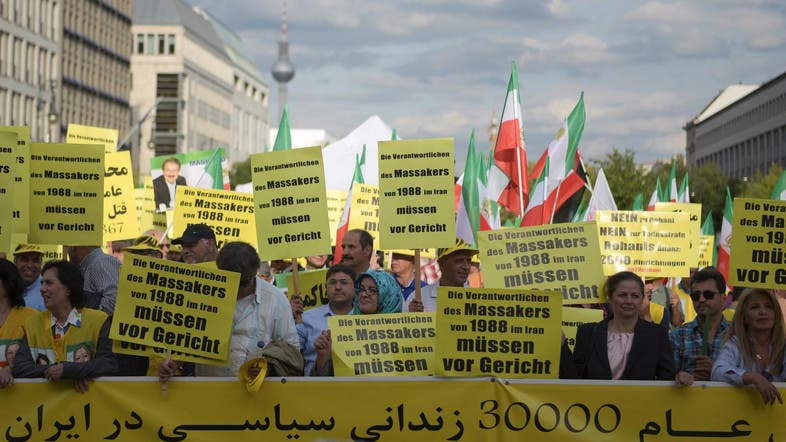
On the anniversary of the 1988 massacre of 30,000 political prisoners in Iran

The 1988 massacre of over 30,000 political prisoners in Iran
has been described as the worst crime against humanity since World War II. [1]
28 years after this genocide, the Iranian regime still refuses to acknowledge the executions, or provide any information as to how many prisoners were killed.
Based on eyewitness accounts of survivors, the massacre had been prepared for from at least a year before. The order for the massacre came from Khomeini directly in the form of a religious decree (fatwa), calling for the execution of all who remained steadfast in their support for the opposition People's Mojahedin of Iran.[2]
A so-called Amnesty Commission (better known among prisoners as the Death Commission) asked a simple question from every prisoner: do you still support the PMOI/MEK? Those who answered yes were executed, even if they had already finished serving their original sentence.[3]None of the victims had any new activities while in detention and many of them were 15 or 16 years of age at the time of original arrest and prosecution.
The executions started in the last week of July, peaking on July 28 until August 14, and continuing onto autumn and even the following year in some places.

Naturally, the vast majority of the victims were members and supporters of the PMOI/MEK, but the order extended to other groups in later stages.

Trump sanctions set stage for necessary regime change

Trump sanctions set stage for necessary regime change


#MEK #Maryam Rajavi #PMOI #Iran #NCRI  #IRGC# Iranian Opposition

Trump administration — eager for legislative accomplishments in the wake of the GOP failure to repeal the Affordable Care Act — can take credit for turning the page on failed Obama-era policy toward the Islamic Republic of Iran. 
The bipartisan passage of the long-anticipated sanctions bill by both houses of Congress allows the administration to take aim at rogue regimes in Iran, Russia and North Korea. Disagreements over U.S. policy toward Russia notwithstanding, the White House can be confident that legislators overwhelmingly support confronting threats emanating from Iran and North Korea and are prepared for even stronger measures to curtail the influence of these dangerous regimes.
The White House should now build on the successful passage of sanctions legislation to push for regime change in Tehran as an appropriate next step.
Trump sanctions set stage for necessary regime change in Iran

Europe must not turn a blind eye to Iran’s human rights abuses

#MEK #Maryam Rajavi #PMOI #Iran #NCRI  #IRGC# Iranian Opposition

Amnesty International has just published a 94-page report entitled “Caught in a web of repression: Iran’s human rights defenders under attack.” It details 45 specific instances of what the organization has described as a “vicious crackdown” coinciding with the supposedly moderate presidency of Hassan Rouhani, who begins his second term in office this week.

The overall takeaway is that Iranian authorities have repeatedly diminished the standards by which they accuse and convict activists and dissenters of national security crimes, while also increasing the severity of punishments that are meted out to those same people. The abusive nature of those punishments was reinforced by new revelations that emerged alongside the Amnesty International report, mainly regarding the Islamic Republic’s notorious overuse of the death penalty.
Iran has long maintained world-leading rates of execution, and the violence and repression of the past few years have been reflected in a pattern of hangings that includes periodic spikes during which dozens of people are put to death in a single month

https://english.alarabiya.net/en/features/2017/08/04/Europe-must-not-turn-a-blind-eye-to-Iran-s-human-rights-abuses.html